使用outline.js为文章H标签自动生成导航目录(Table of Contents)方法
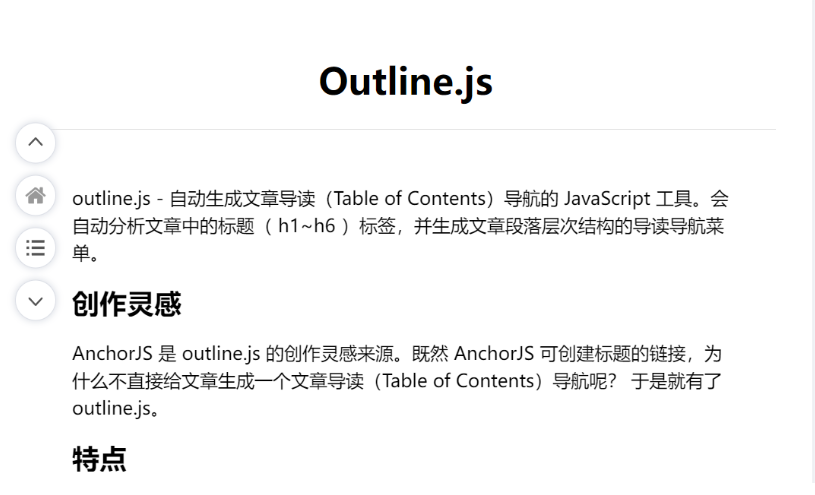
参考链接:
1、https://github.com/yaohaixiao/outline.js
2、https://yaohaixiao.github.io/outline.js/relative.html
3、https://yaohaixiao.github.io/outline.js/flex.html
4、https://yaohaixiao.github.io/outline.js/
引用的资源:
<link href="https://cdn.jsdelivr.net/gh/yaohaixiao/outline.js/outline.min.css" rel="stylesheet" />
<script src="https://cdn.jsdelivr.net/gh/yaohaixiao/outline.js/outline.min.js"></script>
部分说明:
// Node.js 环境中使用
const Outline = require('@yaohaixiao/outline.js')
// 调用其他独立模块(如果需要)
const Anchors = require('@yaohaixiao/outline.js/anchors.min.js')
const Chapters = require('@yaohaixiao/outline.js/chapters.min.js')
const Drawer = require('@yaohaixiao/outline.js/drawer.min.js')
const Toolbar = require('@yaohaixiao/outline.js/toolbar.min.js')

// 作为 ES6 模块使用
import Outline from '@yaohaixiao/outline.js/outline'
// 调用其他独立模块(如果需要)
import Anchors from '@yaohaixiao/outline.js/anchors'
import Chapters from '@yaohaixiao/outline.js/chapters'
import Drawer from '@yaohaixiao/outline.js/drawer'
import Toolbar from '@yaohaixiao/outline.js/toolbar'

// 创建 Outline 实例
// 2.0.0 调整了配置参数,配置更加简单
// 当然,可以直接使用 DEFAULTS 静态属性,
// Outline.DEFAULTS 就是一下的默认配置
const outline = new Outline({
    // 文章显示区域的 DOM 元素或者选择器字符串
    articleElement: '#article',
    // 要收集的标题选择器
    selector: 'h2,h3,h4,h5,h6',
    // 指定文章导读导航菜单的标题文字。
    // 设置空字符串或者 false,则不显示标题
    // 在插入导航菜单的 DOM 元素已有标题时,可以设置 title: '' 或者 false
    title: '目录',
    // 负责文章区域滚动的元素
    // String 类型 - 选择器字符串,默认值:html,body(window窗口)
    // HTMLElement 类型 - DOM 元素
    scrollElement: 'html,body',
    // 文章导读菜单的位置
    // relative - (默认值)创建独立的侧滑菜单
    // sticky - 导航菜单将以 sticky 模式布局(需要确保菜单插入位置支持 sticky 模式布局)
    // fixed - 导航菜单将以 fixed 模式布局,会自动监听滚动位置,模拟 sticky 布局
    // sticky 和 fixed 布局时,需要设置 parentElement
    // 2.0.0 暂时不支持之前版本那种 inside 模式,不会自动在文章开始位置插入 chapters 导航菜单
    position: 'sticky',
    // 导航菜单将要插入的位置(DOM 元素)
    // String 类型 - 选择器字符串
    // HTMLElement 类型 - 插入的 DOM 元素
    // 仅在 position 设置为 sticky 和 fixed 布局时有效
    parentElement: '#aside',
    // 设置 position: relative 时,placment 定义侧滑菜单和 toolbar 导航位置:
    // rtl - 菜单位置在窗口右侧,滑动动画为:right to left
    // ltr - 菜单位置在窗口左侧,滑动动画为:left to right
    // ttb - 菜单位置在窗口上方,滑动动画为:top to bottom
    // btt - 菜单位置在窗口下方,滑动动画为:bottom to top
    placement: 'rtl',
    // 页面中其它 sticky 或者模拟 skicky 的 fiexed 定位的 DOM 元素的高度。例如 wordpress 系统中,
    // 就会有 sticky 定位的导航菜单。这些 sticky 元素脱离了正常的流布局后,原来 h1~h6 标题标签的
    // offsetTop 计算会出现偏差。sticky 元素会遮挡标题,因此针对页面中有其它 sticky 元素会遮挡标题,
    // 因此针对 sticky 布局时,需要设置 stickyHeight 高度。outline.js 会根据 stickyHeight 和计
    // 算出的标题的 offsetTop 值重新计算滚动定位;
    // 说明:outline.js 主要用于文章详情页面,
    // 因此 stickyHeight 仅针对 top: 0,且 sticky 定位元素在文章内容区域上方的位置;
    stickyHeight: 0,
    // 是否显示标题编号
    showCode: true,
    // 指定是否采用动画定位高亮当前的章节标题,默认值:true
    // 当值为 false 时,则采用高亮当前章节标题的链接文字并加粗文字
    // 如果喜欢更简洁的高亮效果,可以选择设置为 false
    animationCurrent: true,
    // 是否显示侧边的按钮工具栏
    hasToolbar: true,
    // 标题图标链接的 URL 地址
    // (默认)没有设置定制,点击链接页面滚动到标题位置
    // 设置了链接地址,则不会滚动定位
    anchorURL: '',
    // 指定当前站点主页地址
    homepage: '',
    // 指定git仓库地址
    git: '',
    // 指定git仓库中的 tags 地址
    tags: '',
    // 指定git仓库中的 issues 地址
    issues: '',
    // 自定义按钮配置
    tools: [],
    // 为文章页添加基础的打印样式
    // 如果您的页面已经有打印样式,就无需设置了
    print: {
      //(必须)要打印的文章区域,DOM 元素或者选择器字符串。
      element: '',
      // (可选)要打印的文章标题。如果 element 区域有 h1 标签则无需设置。
      // 可以直接设置标题文本,也可以是文章页的主标题 DOM 元素
      title: '',
      // 进入阅读模式的提示消息文本
      enterReadingTip: '进入阅读模式,按 ESC 键可退出阅读模式'
    },
    // DIYer的福利
    // 独立侧滑菜单时,customClass 会追加到 drawer 侧滑窗口组件
    // 在文章中显示导航菜单时,customClass 会追加到 chapters 导航菜单
    customClass,
    // position: fixed,当导航菜单样式进入 fixed 定位后,触发的回调函数
    afterSticky: null,
    // 当导航菜单隐藏或者显示后,触发的回调函数
    afterToggle: null,
    // 当点击上下滚动按钮,导航菜单或者文章中的 # 图标,滚动结束后触发的回调函数
    afterScroll: null,
    // 文档的标题文本过滤回调函数
    // API 文档中,正文的方法会添加参数等信息,例如:getChapters(headings, showCode, chapterTextFilter)
    // 而在 chapters 导航菜单,我希望显示为 getChapters(),这时我们就可以借助 chapterTextFilter 回调函数
    // 对原始的文本进行过滤,返回我们期望的 getChapters() 文本
    chapterTextFilter: null
});

// 可以在创建导航后,重置配置信息,重新生成新的导航
Outline.reload({
  // 调整位直接在文章内生成导航
  position: 'sticky',
  articleElement: '#article'
})